Chicory Root Inulin
Cichorium intybus (root) 211 mg per capsuleThe largest single component of the capsule, and one of the best-characterised prebiotic fibres there is — studied at amounts roughly twenty-five to fifty times larger.
Learn moreSodaTide is a once-daily capsule combining prebiotic fibres with a three-strain probiotic blend, designed to support gut microbiome balance, digestive comfort and metabolic energy use. This is an independent look at what the capsule actually contains — with the per-capsule amounts read straight from the product label.
A dietary supplement for healthy adults 18 and over, intended to support everyday wellness alongside a balanced diet and regular activity. Individual results may vary, and no outcome is guaranteed. Not intended to diagnose, treat, cure or prevent any disease, and not a treatment for any digestive disorder.
The document the available material said it could not reach — and the reason this site can publish figures nobody else does.
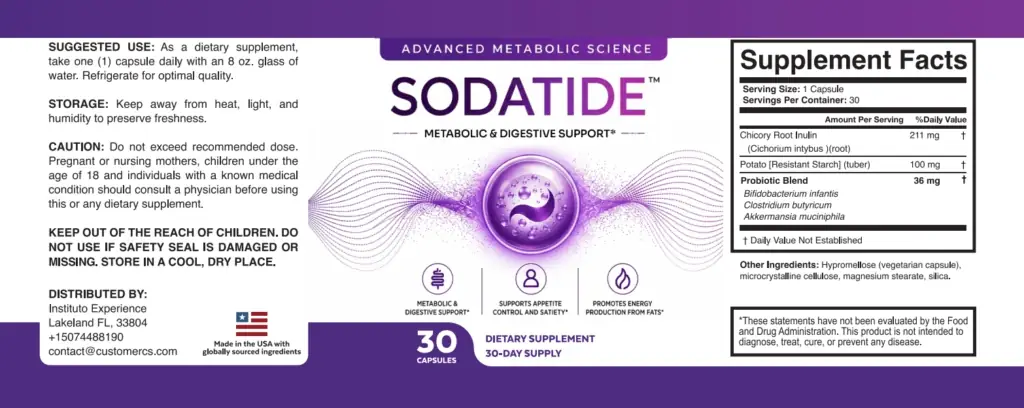
What the panel establishes: serving size one capsule; 30 servings per container; chicory root inulin (Cichorium intybus, root) 211 mg; potato resistant starch (tuber) 100 mg; probiotic blend 36 mg comprising Bifidobacterium infantis, Clostridium butyricum and Akkermansia muciniphila; daily value not established for any of the three. Other ingredients: hypromellose (vegetarian capsule), microcrystalline cellulose, magnesium stearate and silica. Suggested use: one capsule daily with an 8 oz glass of water, refrigerate for optimal quality. Distributed by Instituto Experience, Lakeland FL; made in the USA with globally sourced ingredients.
Two things the label settles that no description of the formula could.
The material this site draws on is unusually candid about its own limits. It states that SodaTide's official website was not accessible, that its details come from a third-party review and the packaging, that it could not cross-check the formula against an accessible official label — and it tells readers to verify against the physical bottle.
That is what this site did. The product label carries a full Supplement Facts panel, and it answers the open question. Read directly from it:
The three strains, named on the label beneath the blend: Bifidobacterium infantis, Clostridium butyricum and Akkermansia muciniphila.
Why the amounts change the picture. Without them, an ingredient list cannot be checked against anything. With them, the comparison is arithmetic: 211 mg of inulin is roughly one twenty-fifth to one fiftieth of a studied prebiotic dose, and 100 mg of resistant starch roughly one hundred-and-fiftieth to one three-hundredth of one.
That is not concealment — the figures are printed on the bottle. It is a physical constraint: fibre is bulky, and a single small capsule cannot hold a gram-scale dose of it. A bowl of oats, a pear or a serving of beans supplies several grams of fermentable fibre. It is the fact that matters most when judging what one capsule a day can realistically do.
The source material describes “6 ingredients” and lists them as: chicory root inulin, potato resistant starch, probiotic blend, Bifidobacterium infantis, Clostridium butyricum and Akkermansia muciniphila.
Items four, five and six are item three. They are the three strains that make up the probiotic blend, not three further ingredients standing alongside it. Counting them separately counts the same material twice.
The label settles it. The Supplement Facts panel declares three line items — inulin, resistant starch and the probiotic blend — with the three strain names indented beneath the blend, which is the standard way a blend and its constituents are printed.
This is a counting slip rather than a false claim, and it is easy to make. But “six ingredients” makes a formula sound twice as substantial as it is, so this site says three throughout, and names all three strains inside the blend where they belong.
The label declares the probiotic blend by weight — 36 mg. That is the one figure on the panel that cannot be interpreted.
Probiotics are dosed in colony forming units, not milligrams. A CFU count measures how many live organisms you actually swallow. A weight tells you how much powder is in the capsule, and that powder is mostly carrier material. Two products both declaring 36 mg could differ by several orders of magnitude in live organisms, and nothing published distinguishes them.
Typical probiotic research uses doses in the region of one to fifty billion CFU a day, and trials report the figure because it is the variable that matters.
What this means practically: the strains are named, which is better than most blends manage, but the amount of live culture cannot be established from any published source. That is a fair question to put to the seller before ordering six months' worth.
Everything below is read from the product label or stated in the source material.
The problem the product aims at is real, even where the dose is small.
Common guidance puts adult fibre intake somewhere around 25 to 38 grams a day depending on age and sex. Typical intake in many countries is roughly half that.
That shortfall genuinely does affect digestion, regularity, satiety and the shape of the blood-sugar curve after eating — the exact list SodaTide is positioned against. So the target is well chosen.
The honest complication is scale. A cup of cooked beans supplies something like 12 to 15 grams of fibre. A pear with the skin on, about 5. This capsule supplies 311 mg of fibre in total. The source's own advice to eat a fibre-rich diet alongside it is the most useful line on the page.
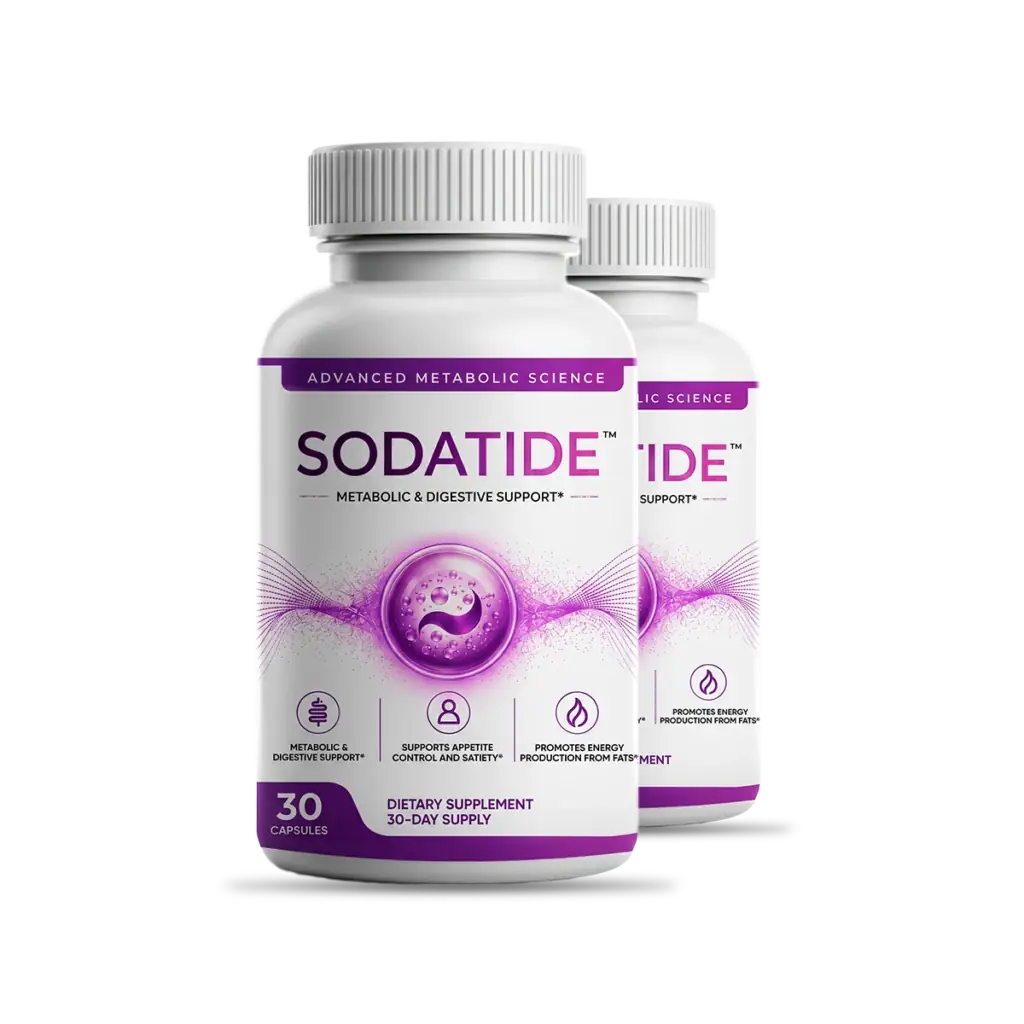
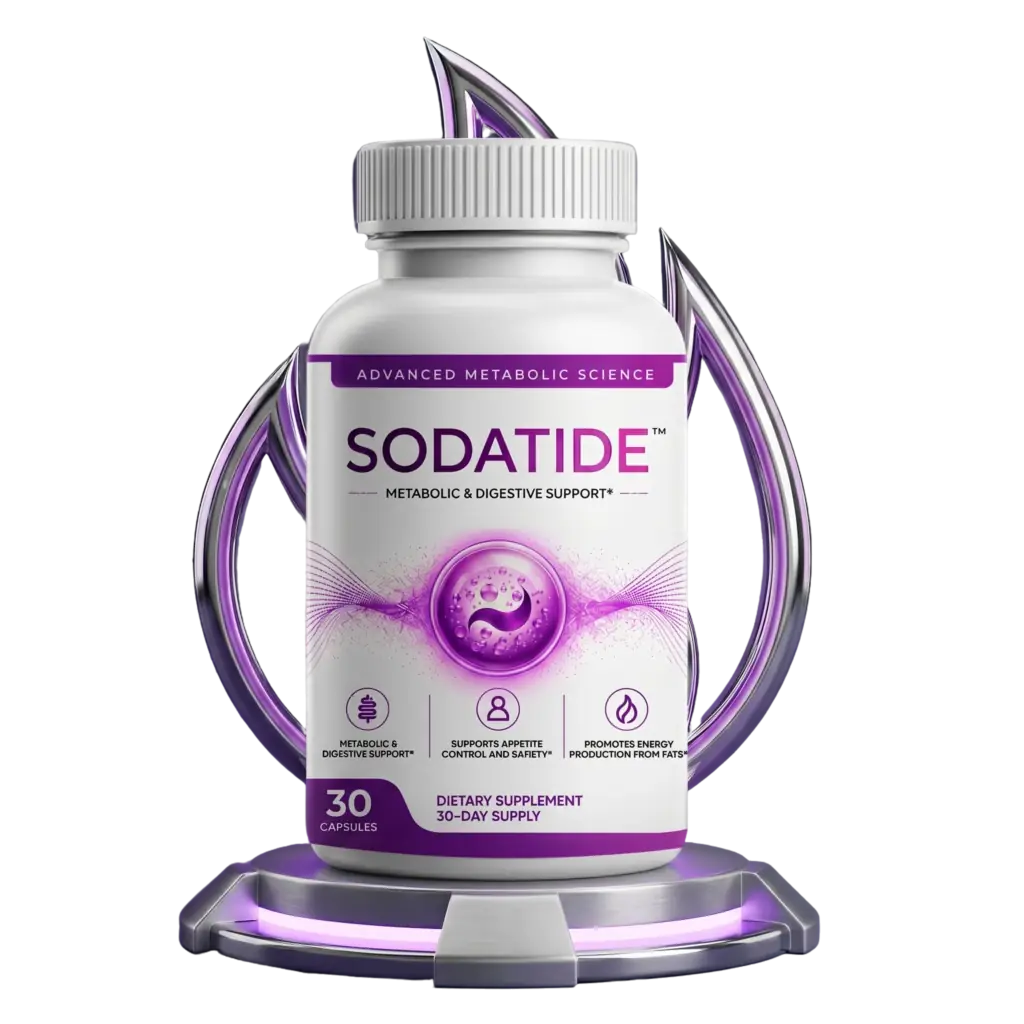
SodaTide is a once-daily vegetarian capsule described as a synbiotic — prebiotic fibre and live probiotic strains in the same dose, rather than probiotics on their own. One capsule, thirty to a bottle, taken with a glass of water.
The premise is more specific than most of this aisle, and worth stating fairly: instead of stimulants or appetite suppressants, it feeds the bacteria already in your colon and adds three live strains of its own. Pairing the two is a recognised approach with real biology behind it.
The question this site answers is whether the amounts on the label can act on that premise — a question the available material could not answer, because it could not reach an official label.
What the label declares
The material this site draws on is candid about its own limits. It says the official SodaTide website was not accessible, that its details come from a third-party review and the packaging, and that it could not cross-check the formula against an official label. It tells readers to verify against the physical bottle.
That is a responsible thing to write, and it is exactly the check this site made. The label carries a full Supplement Facts panel.
With amounts in hand, an ingredient list stops being a set of names and becomes something you can measure against the published research.
One capsule, once a day, with a full glass of water — preferably at the same time each day, since consistency is what the product depends on. The label adds one more instruction that is easy to miss: refrigerate for optimal quality.
There is nothing to measure and no schedule to follow. That matters for a product whose own rationale is that gut balance builds gradually over weeks: the most common reason supplements do nothing is that people stop taking them.
Plan the refrigeration before you order. Six bottles is 180 days of fridge space, shipping is not refrigerated, and a capsule you must keep cold is harder to take consistently when you travel.
Three declared components, each with the amount the label gives and a page of its own.
The largest single component of the capsule, and one of the best-characterised prebiotic fibres there is — studied at amounts roughly twenty-five to fifty times larger.
Learn more
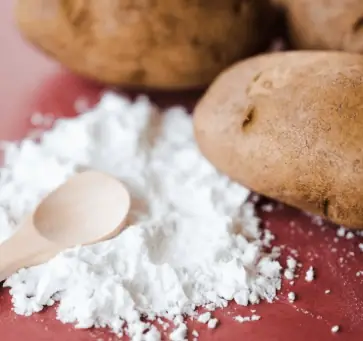
A starch that escapes digestion and ferments further along the colon than inulin — and the ingredient with the widest gap between label amount and research amount.
Learn more
Three strains in one declared blend — not three separate ingredients, which is where the “six ingredients” count comes from. No CFU count is published anywhere.
Learn moreThe synbiotic mechanism, described fairly, with the caveats attached.
Inulin and resistant starch both resist digestion in the small intestine and arrive in the colon still whole, where resident bacteria ferment them. This is well-established physiology, not a marketing construct.
Chiefly butyrate, propionate and acetate. Butyrate is the primary fuel for the cells lining the colon, and short-chain fatty acids are studied in connection with the gut hormones GLP-1 and PYY, which are involved in fullness signalling.
The caveat: that research used gram-scale fibre doses. 311 mg of combined fibre produces correspondingly little fermentation.
The most thoughtful part of the formula. Inulin ferments early and briskly; resistant starch ferments later and further along the colon. Pairing them spreads the feeding rather than concentrating it — a real formulation decision.
That is the synbiotic idea, and it is sound in principle. The three strains are named on the label — Bifidobacterium infantis, Clostridium butyricum and Akkermansia muciniphila.
The caveat: no CFU count is published, so how many live organisms arrive is unknown.
Clostridium butyricum produces butyrate, which is exactly what the fibre fermentation is aiming at, and Akkermansia lives in the mucus layer and is studied for barrier integrity. A balanced gut environment is also studied in relation to satiety signalling.
These are genuine research areas. They are also the parts most dependent on live organism counts nobody has published.
Every step above is real biology, and the source describes it more carefully than most. What none of it establishes is that 347 mg once a day is enough to move any of it measurably. There is no clinical trial of the finished capsule, and the ingredient research was conducted at doses ten to three hundred times larger.
The source singles out Akkermansia muciniphila as “a well-studied strain associated with gut barrier support — not present in every gut-health formula”. That is a fair characterisation and worth agreeing with.
Akkermansia lives in the mucus layer lining the gut and feeds on mucin, the protein that layer is made of. By grazing on it, it appears to stimulate its renewal. Observational studies repeatedly find lower abundance in people with obesity and type 2 diabetes, and a small number of human intervention studies have reported improvements in metabolic markers.
Two honest qualifications. Most of the striking findings are from animal work, and the human evidence base is still small. And Akkermansia is a strict anaerobe that is notoriously difficult to keep alive — much of the human research has used pasteurised, non-viable cells. Nothing published states whether the Akkermansia in this capsule is live or pasteurised, and with no CFU count either, that part of the formula cannot be assessed.
The source cites real work — a PubMed Central paper on chicory root inulin as a prebiotic fibre, a PubMed entry on Akkermansia muciniphila and gut barrier function, and a general reference on resistant starch. These are genuine research areas, not invented ones.
It also states the necessary caveat itself, and clearly: “these citations concern research on individual ingredients, not the finished SodaTide product”. There is no clinical trial of this capsule.
The piece the citations cannot supply is the amounts. That research was conducted at grams per day of fibre; this capsule contains 347 mg of active material in total. The research explains why these ingredients are interesting. It does not show that this capsule reproduces the results.
Three things genuinely in its favour, and three worth knowing before you buy.
It admits the official site was unreachable, refuses to repeat an unverified 4.93/5 rating, and says its citations concern ingredients rather than the finished product. That is rare in this category.
Two fibres that ferment at different rates, paired with a butyrate producer and a barrier-associated organism. Akkermansia is genuinely uncommon in off-the-shelf formulas.
The compare-at figures are $79 × bottles — the real two-bottle rate — not an invented retail price. Modest, and honest about it.
211 mg and 100 mg against research conducted at 5–10 g and 15–30 g a day. That gap is the single most important fact here.
The blend is declared by weight. Weight cannot tell you how many live organisms you are getting, and nothing published closes that gap.
The count includes the probiotic blend and then its three strains separately. The label declares three line items.
Four claims stated exactly as the label and the source state them.
The badge is worded accurately: registered facility, not approved product. The source says the same, unprompted.
Good Manufacturing Practice governs cleanliness, records and batch control. It concerns the plant and the process, not the formula.
The label's fuller wording is “made in the USA with globally sourced ingredients” — manufacturing is domestic, raw materials are not necessarily.
Described as a positioning rather than a third-party certification, and no certifying body is named.
None of these is a statement about whether the formula works. They describe where and how it is made.
Agreement first, because there is a lot of it. The source discloses that the official website was not accessible to it and that its details come from a third-party review and the packaging; refuses to repeat an unverified star rating; states that its research citations concern individual ingredients rather than the finished product; says supplements are not FDA-approved; labels its own formula-target list “illustrative … not measured clinical outcomes”; discloses its affiliate commission; warns about mild digestive adjustment, 18+ only, pregnancy, immune compromise and medication; and says the product is not a treatment for any digestive disorder. All of that is carried forward.
What this site adds: the per-capsule amounts and the three strain names, read from the product label — the check the source told readers to make themselves.
What this site corrects: the “six ingredients” count, which counts the probiotic blend once and then again as its three strains.
What this site does not carry forward: the three named testimonials with portraits, stars and “Verified purchase” labels; the suggestion that spacing SodaTide from other supplements aids absorption, for which no support is offered; and the panel of green “Supported” ticks against gut balance, digestion, appetite and metabolic energy — the source calls it illustrative, which is honest, but a grid of ticks reads as measured findings and none exist.
Credit where it is clearly due. The source material notes that some third-party sites advertise an aggregate score of around 4.93 out of 5 for SodaTide, and then explicitly declines to repeat it: it could not verify the figure through an independent review platform, so it presents customer comments as individual opinions rather than restating an unverified rating as fact.
That is exactly the right call, and it is rarer than it should be in this category.
This site goes one step further. The source still publishes three named testimonials with portraits, star ratings and “Verified purchase” labels. No independent platform is named or linked for those either, which means there is nowhere to read them in context, no way to count them, and no way to see unfavourable ones. So no testimonial text, customer name, portrait, star rating or review count appears anywhere on this site, and no rating appears in its structured data. Nothing has been invented in their place.
No dietary supplement is, and the source says so plainly: produced in an FDA-registered facility, and “supplements are not FDA-approved”. That is accurate and it is carried forward here.
Facility registration is a listing requirement for the plant where a product is made. It is not an evaluation, an endorsement or approval of anything made there. The badge used on this site is worded accurately — it reads “FDA Registered Facility”.
The same applies to GMP. Good Manufacturing Practice governs how a facility is run — cleanliness, record keeping, batch control. It is meaningful and worth having, and it says nothing about whether a formula works or whether the amounts in it are useful.
The source's framing is fair: gut balance builds gradually, and improvements — if any — are reported after several weeks of consistent daily use rather than immediately.
Hold that against the label. 347 mg of total active material, against research conducted at gram-per-day doses. A realistic expectation is that you may notice some digestive change in the first week — most likely gas, as any fibre supplement produces — and comparatively little beyond that.
What to do instead of hoping: decide in advance what you would actually notice, note where it stands before you start, change one thing at a time, and note your purchase date so you know when the 60-day guarantee window closes.
The label says: one capsule daily with an 8 oz glass of water, and refrigerate for optimal quality.
The source adds: preferably at the same time each day for consistency, refrigerate to help maintain probiotic potency, expect gut balance to build gradually over several weeks, and support it with a varied, fibre-rich diet.
These agree completely, which is reassuring — the packaging instruction and the written guidance were evidently drawn from the same place. The advice to eat a fibre-rich diet alongside is the most useful line in it, for reasons the amounts make plain.
The label says “Refrigerate for optimal quality” and to keep the bottle away from heat, light and humidity. The source repeats it and rightly calls it “a small but meaningful detail some people miss”.
Credit where it is due. Asking buyers to refrigerate is a live-culture instruction rather than a marketing flourish, and it is a point in the product's favour that it is stated at all — plenty of probiotic products quietly skip it.
The practical consequences are worth thinking about before you buy:
The source is careful here and the label agrees with it. For healthy adults 18 and over; not for anyone under 18 or for pregnant or nursing women; and talk to your doctor first if you have a compromised immune system, a serious digestive condition, or take medication.
SodaTide is a dietary supplement, not a medicine, and is not intended to diagnose, treat, cure or prevent any disease.
SodaTide is a dietary supplement, not a treatment for any medical condition. The source says this itself, more than once, and it is right to. It is not a treatment for irritable bowel syndrome, inflammatory bowel disease, obesity, diabetes or any other condition.
Some symptoms need a doctor rather than a supplement, and this is worth being specific about. Sudden or unexplained weight loss, persistent abdominal pain, blood in the stool, a lasting change in bowel habit, or difficulty swallowing all need clinical assessment. So does persistent fatigue, which has causes a blood test can find — anaemia, thyroid disease, coeliac disease, diabetes and sleep apnoea among them.
A prebiotic capsule cannot distinguish between ordinary bloating and something that needs investigating. A doctor can.
The source gives good advice almost in passing: support the capsule with a varied, fibre-rich diet. That advice deserves more weight than it gets, because of the arithmetic.
Most adults eat far less fibre than recommended. Common guidance is around 25–38 grams a day depending on age and sex, and typical intake in many countries is roughly half that. That shortfall is the single biggest lever on exactly the things this product is sold for: digestion, regularity, satiety and post-meal blood sugar.
For scale: a cup of cooked beans or lentils supplies somewhere in the region of 12–15 grams of fibre. A pear with the skin on, around 5 grams. A bowl of oats, roughly 4 grams. A cooled cooked potato — the very source this product's resistant starch comes from — supplies resistant starch in grams.
Against those figures, 311 mg of combined fibre is a rounding error. That is not an argument that the capsule is worthless; a probiotic dose is a different proposition from a fibre dose. It is an argument that no capsule substitutes for food, and that anyone buying this for digestive benefit will get far more from adding beans, oats, fruit and vegetables than from anything in a 347 mg capsule.
The three bundles listed in the available material, with the compare-at figures explained rather than simply repeated.
$158 total
The seller lists a compare-at figure of $158 here — identical to the price, so it shows no saving at all.
Compare at $474 → $294 total
A difference of $180
Compare at $237 → $207 total
A difference of $30
What the “compare at” figures actually are. $158, $237 and $474 work out to exactly $79 per bottle in every case — the two-bottle rate applied across each bundle size. They are not a former retail price, and the source describes them as reference figures reported by third parties. That is a more conservative way to show a discount than the invented recommended-retail anchors common in this category, and it is worth crediting. It also means the real differences are modest: $0 on two bottles, $30 on three and $180 on six. Free US shipping applies to the three- and six-bottle bundles; the two-bottle bundle adds $9.99. Promotional pricing is set at checkout and can change, so confirm the current offer there before paying.
Sixty days from the date of purchase. If the product does not meet your expectations you can request a refund through customer support within that window. The purchase is stated to be one-time, with no rebill.
Unlike some pages describing this product, the source used here states no minimum use period before a refund can be requested — so no such condition is asserted on this site. Confirm the current terms on the official refund policy before ordering, since they are the seller's to set and to change.
The window is 60 days. The supply you buy may last considerably longer.
Note your purchase date the day you order, as the source itself advises. Two details are not published anywhere: who pays return postage, and whether opened bottles are accepted.
Fifteen straight answers, including the amounts read from the label.
SodaTide is a once-daily vegetarian synbiotic capsule — prebiotic fibre and probiotic strains together — sold as support for gut microbiome balance, digestive comfort, appetite regulation and metabolic energy use. Thirty capsules per bottle, a 30-day supply.
Read from the product label: chicory root inulin 211 mg, potato resistant starch 100 mg, and a probiotic blend of 36 mg containing Bifidobacterium infantis, Clostridium butyricum and Akkermansia muciniphila. Total active material is 347 mg. Full breakdown here.
Three. The formula is often described as having six, but that list counts the probiotic blend once and then again as its three individual strains. The label declares three line items, with the strain names indented beneath the blend. Explained here.
From the product label itself. The material this site draws on notes that it could not access an official label and advises verifying against the physical bottle — so that is what was done. The Supplement Facts panel carries all three amounts and names all three strains.
Not much, and this is the key fact. Prebiotic inulin trials typically use 5–10 grams a day; resistant starch studies typically use 15–30 grams. This capsule has 211 mg and 100 mg. Fibre is bulky, and no single small capsule can hold a gram-scale dose.
Not published anywhere, including on the label. The blend is declared by weight (36 mg), and weight cannot be converted to colony forming units.
One capsule daily with an 8 oz glass of water, preferably at the same time each day. Refrigerate for optimal quality.
Yes — the label says “Refrigerate for optimal quality.” Live probiotic organisms lose potency in heat. Worth planning for: a six-bottle bundle is 180 days of fridge space, and shipping is not refrigerated.
Yes. The capsule shell is hypromellose, a plant-derived material, and the formula is described as vegetarian and non-GMO.
Three: two bottles at $79 each ($158 plus $9.99 shipping), three at $69 each ($207), and six at $49 each ($294). Free US shipping on the three- and six-bottle bundles.
They are $79 × the number of bottles — the two-bottle rate applied across each bundle, not a former retail price. That is a more conservative anchor than most pages use. It also means the real differences are modest: $0, $30 and $180. Full breakdown here.
60 days from the date of purchase, requested through customer support. The source used here states no minimum use period, so none is claimed. Note your purchase date — only the two-bottle bundle is a supply short enough to finish inside the window.
No, and no dietary supplement is. It is made in an FDA-registered facility, and registration applies to the facility rather than the product. The source states this correctly itself.
No. Individual results may vary. There is no clinical trial of the finished capsule, and the research cited concerns the individual ingredient categories rather than this product.
It may, in the first week. Mild, temporary digestive adjustment is the normal response to any prebiotic or probiotic, and it usually settles. If you have IBS or follow a low-FODMAP diet, note that inulin is a fructan.
Read the ingredients page first. This site publishes the per-capsule amounts and the three strain names read directly from the product label — doing exactly what the source material recommends when it tells readers to verify against the physical bottle.
From $49 per bottle · 60-day money-back guarantee · One capsule a day